
A.I. at Orono
How New Technology Will Change Your Kids' Education

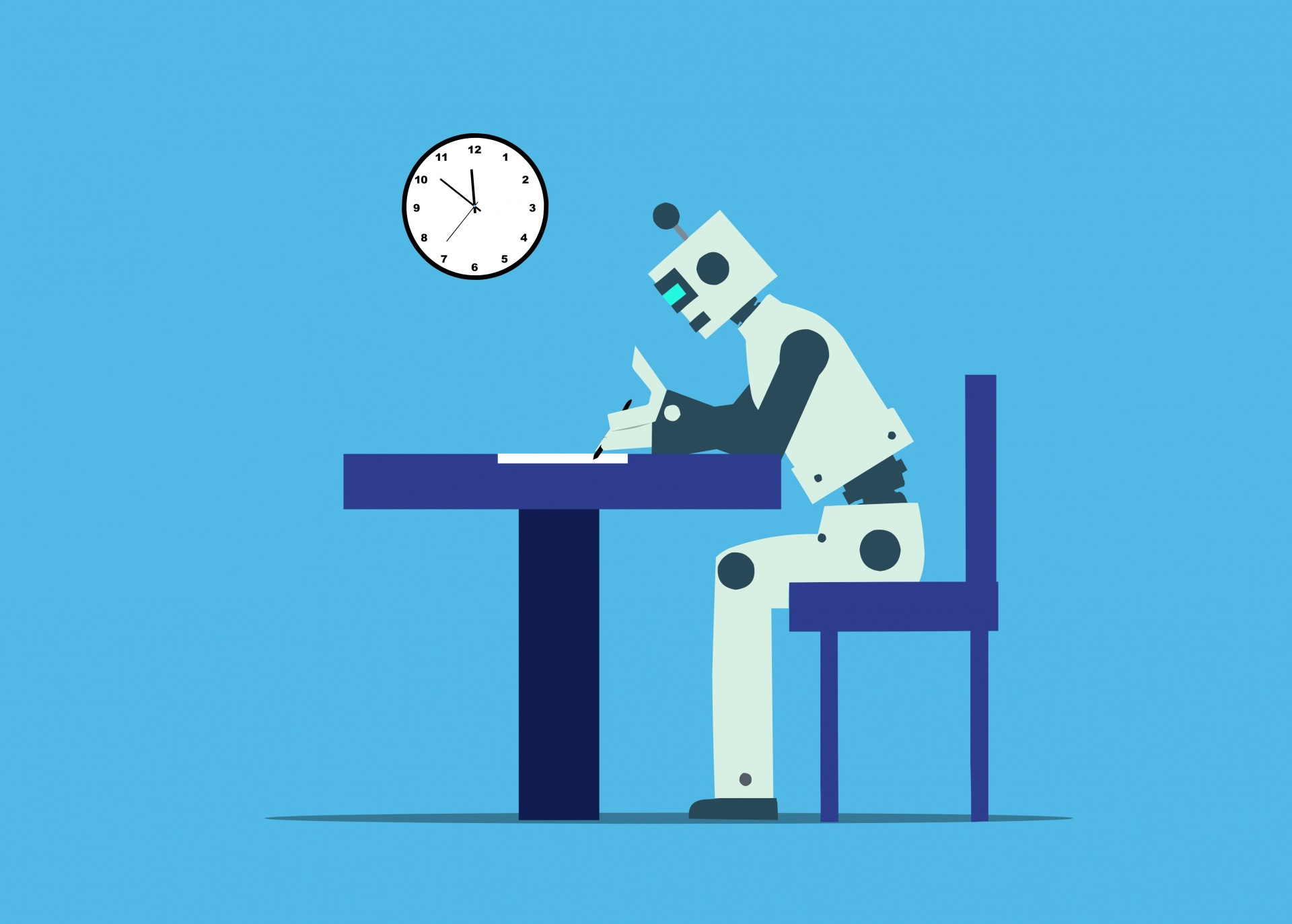
Artificial Intelligence is going to school. By now, we’ve all heard and seen at least a little bit of what programs like ChatGPT and Midjourney can do, and one thing that many parents are thinking about – or should be thinking about – is how this technology is going to affect their children’s education.
The first thought that occurs to many is that A.I. will be used to cheat. Certainly, large language model tools (LLMs) like ChatGPT and Google’s Bard could be used in illicit ways, but there is also great potential for positive use.
Parents of school-age children, then, are left with the question of what to do about A.I. in their kids’ education, and what their schools are already doing. Here in Orono School District, I talked to the technology coordinator, Sean Beaverson, to learn some details about how our schools are preparing for the impact of A.I. right now.
We started by talking about what is probably the most obvious concern: plagiarism. But Beaverson points out that figuring out what exactly counts as plagiarism can be a little tricky when considering A.I. For instance, if a student tells ChatGPT to write a 700-word essay on Romeo and Juliet and then submits whatever comes out, that’s obviously no good, but it may not exactly be plagiarism either, since the student didn’t copy a pre-existing essay and claim it as his own. Furthermore, what if a student copy-pastes his own rough draft into ChatGPT and asks for some suggestions on how to smooth out his conclusion? Is there a meaningful difference between taking blocks of text generated by A.I. and taking its advice?
This gets to the heart of the concern that Beaverson is focusing on as the technology coordinator: ethical use of Artificial Intelligence. He summarized the problem this way:
“If we say [. . .] you can’t plagiarize, but then a kid says ‘it’s not plagiarism, because it’s unique. No one else has generated this prompt outcome that my prompt did, so it’s not plagiarism,’ well, then we get into splitting hairs around this category called plagiarism. But if we talk about ethical use, what is ethical use in school? Ethical use is fairly representing what you have learned, and how you have learned and can deal with that new information. That’s what the outcome of learning should be. That’s how we know if students are growing. Like, the whole point of the grades, the performance piece of any class, is to demonstrate that you’ve gained those new skills and abilities so that you can use them in a novel way, to either share your understanding of the knowledge that you’re using or to create something new based on what I’ve given you. And so, the umbrella category for me is ethical use. And then, we already have board policy on what acceptable use is on our campus. We have a board policy called Acceptable Use and, in that policy, it calls out that you can’t cheat, as a matter of course, using technology. And so, I think, I have a suspicion that our current policy could be interpreted to apply to A.I., but what I’m curious about is that, while that may be true, we may also need to add clarity around this specific technology that is A.I.”
In addition to plagiarism, one of the biggest concerns about A.I. in education is that it may be used to get easy answers on homework. It doesn’t take much imagination to conceive of a student simply plugging their homework questions into ChatGPT and writing out whatever the program says.
While it’s true that that could happen, that’s not really new to A.I.. Google can serve the exact same function with only slightly less efficiency, and a student trying this will run into the exact same problem when it comes time to take a test: they won’t really know the material. The same students who would cheat with A.I. are probably already cheating with Google, and the honest students will remain honest. But if you’re a parent and you’re worried about the temptation to cheat with A.I., don’t hesitate to tell your kids that A.I. can be wrong, because it can.
For example, I wanted to know what kind of questions someone could expect to find on the exam administered by the State of Minnesota to obtain a Power Limited Technician’s license, so I asked Google’s Bard. Bard confidently provided me with an overview of the test and even some practice questions from a review guide it found on the state website – for the wrong license exam. I pointed out to Bard that it had given me the wrong information, and it recognized that I was correct, and then found more accurate information based on my prompting.
A.I. may indeed be a useful tool for research, proofreading, math practice, and many other things, but it is far from infallible and it does not possess a license on absolute truth. Anybody using A.I. should be prepared to check and double-check any info they get from A.I., especially if they are asking more abstract questions. One only has to ask ChatGPT one or two questions about hot-button political or social topics to observe a built-in bias.
Getting past the potential ill uses of A.I., the possibilities for A.I. as a powerful educational tool are considerable. With a little thought, you can imagine a situation where teachers are using A.I. to compose, in minutes, the kinds of everyday quizzes and in-class exercises that normally consume hours of work. As a result, they would be able to spend much more time and effort reviewing student’s answers and identifying specific students’ particular areas of strength and weakness. From there, they could much more efficiently craft lessons that target those areas where students are struggling. In our conversation, Beaverson highlighted the value of what he called “leveled readings,” which is a way of creating the same test or activity at varying levels of difficulty, so that every student can be working right on the edge of their capabilities. This would be a way to combat one of the greatest weaknesses of the classroom: that most students in a given class will either be ahead of where the teacher is at and therefore not being challenged, or behind the teacher and not able to catch up.
In addition to leveled readings or tiered tests, A.I. could be used as a sort of teaching assistant. With a careful set of parameters programmed into the A.I., and with a little coaching on how to use it, many students in the same classroom could be receiving personal attention and instruction, not from the teacher, but from ChatGPT or Bard. This way, while the teacher can only directly help one student at a time, every student can be receiving some assistance and coaching from the A.I. until their question is answered or until the teacher can get to them. One could imagine the same method being used at home. If a student is struggling with his math homework, and his parents are busy or don’t understand the problem themselves, A.I. could help walk him through the steps of the problem until he gets a handle on it.
That may seem like a rosy picture. The scenarios I’ve painted in this article assume cooperation, motivation, and competence from all parties involved, and that may not be the case at all times. Even so, the possibilities are there for A.I. to be a tool that pushes more students to their limits and beyond, and enables skilled teachers to customize their instruction for their students more than ever before.
All of this is well and good, but what can parents do about it? First, you can experiment with A.I. yourself! You can sign up for a free OpenAI account right now in a few clicks and start playing around with ChatGPT. If you have access to Google, then you already have access to Bard. Ask the programs some history questions. Ask them to quiz you on algebra. Ask it to write you a draft of a work email, then have it refine the draft a couple of times based on your feedback. See what happens. You’ll likely realize either that these programs are not as almighty as you may have been led to believe, or that they have more potential utility than you thought.
You can also talk to your kids about if, and how, they are already using A.I. Whether they haven’t used it at all, or if they’re asking ChatGPT to write jokes and help them with their math homework, you can get on the same page with them about your expectations. And if you have dipped your toes into the A.I. ocean already, it will be that much easier to communicate your expectations to them.
Furthermore, as far as your kids’ school is concerned, you can reach out to the administration with your questions. Here in Orono, it was very easy to find time to talk to our technology coordinator. I sent him an email with over a dozen questions, and he was quick to find time for us to get together in-person so that he could better address the issue. You can also find contact information for our superintendent, school board members, and teachers at this website to ask them any questions you might have about how the school is handling A.I. in the classroom.
In the end, A.I. is just another tool. Like the internet before it, and the automobile, and the printing press, it will likely change a great many things about our daily lives in the coming years, but all we can do is learn about this tool, decide how we want to use it, how to let our children use it, and to hold those in authority accountable for finding and implementing the best policies.